



We’ve tested a lot of portable power stations over the last few years.
What started with carrying a small Jackery around on camping trips eventually turned into testing everything from tiny sub-300Wh units to 2,000Wh+ monsters capable of running kettles, fridges, tools and large parts of our boat while we renovated it.
We’ve used them on:
We’ve also tested them with folding solar panels, expansion batteries, high-draw appliances, and low-draw 12v appliances.
Every brand included below is one we’ve personally used.
That doesn’t mean I’ve tested every single model that each brand currently sells. In fact, with brands like Jackery and Anker, some of the exact models we originally tested have since been replaced by newer generations.
So I’m going to make that distinction really clear throughout:
That matters because there really isn’t one “best portable power station” for everyone.
A 245Wh EcoFlow RIVER 3 and a 2,000Wh+ Anker SOLIX are solving completely different problems.
If you’re camping for a weekend and only charging phones, laptops, lights and action cameras, the big station is ridiculous.
If you’re living in a campervan for weeks and want to run a fridge, laptops and higher-draw appliances, the tiny one is equally ridiculous.
So, start with how much power you actually need.
Then choose the best unit for that job.
Let's get started ...
Here’s how I’d narrow the market down today.
A quick note before we get into them...
Some of the current recommended models above aren't the exact models we originally tested.
I don't think that's a reason to ignore the rest of a brand's range.
If I've spent months with a 2,000Wh Anker and you only need a 300Wh station, I'm not going to tell you to buy a giant Anker just so I can say I touched the exact model.
Instead, I'll explain what my firsthand experience tells me about the brand, then clearly separate that from the current specifications of their newer models.
I don't have a giant laboratory full of oscilloscopes.
And I don't think pretending otherwise makes this guide more useful.
I test power stations in the sort of situations we actually use them in.
That has included:
We've also had a traditional campervan electrical system with leisure batteries, inverter, solar and alternator charging.
So when I say a power station could genuinely replace a more traditional setup for some campervan builds, I'm comparing it against something we actually lived with for years and drove halfway round the world.
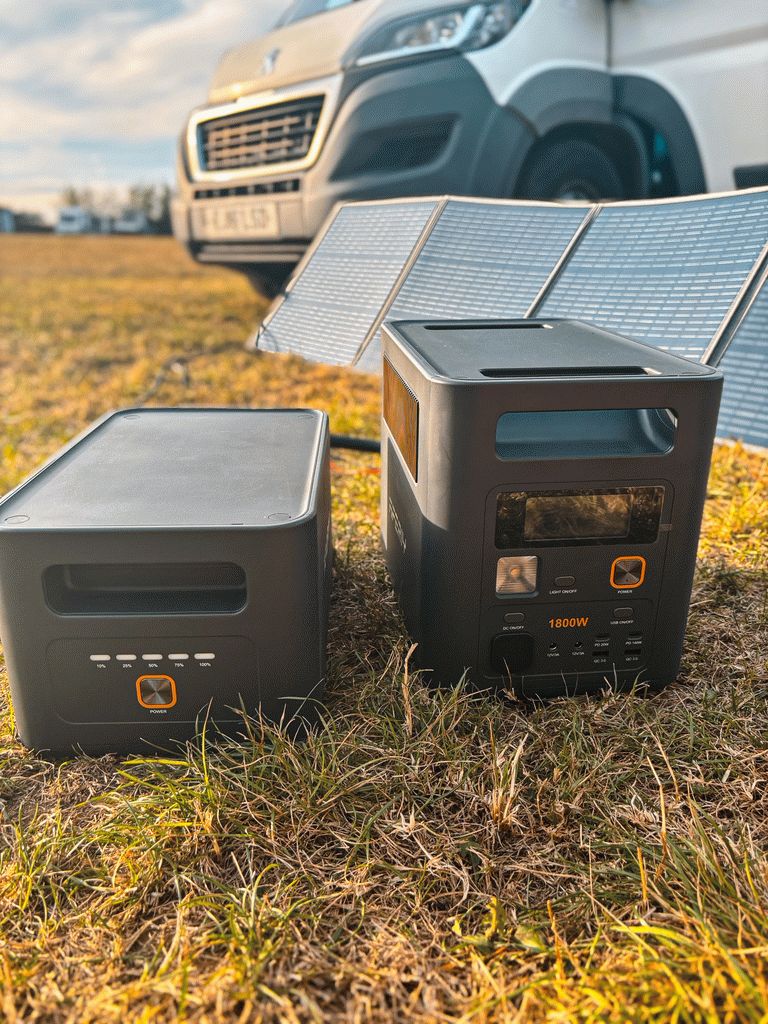
If I was starting from scratch and wanted one sensible power station for camping and campervan use without spending silly money, the AFERIY P180 Pro is probably where I'd start.
It has:
I've now tested the P180 Pro with its expansion battery and 200W solar panel, and it hits a very useful sweet spot.
It's small enough that I genuinely wouldn't mind keeping it in a campervan, but the 1,800W inverter is large enough to move beyond just charging phones and laptops.
During my testing I had it around its 1,800W rated output without issue. I then deliberately pushed it to roughly 2,650W with our kettle, at which point the overload protection eventually kicked in and safely shut the AC output down.
That's exactly what I want.
Another tiny feature I loved was the physical switch for changing AC charging speed.
On plenty of modern stations you need to open an app and swipe through settings just to change input power.
Here?
Flick a switch.
Much better.
You can read all of those tests in my full AFERIY P180 Pro review.
We've also tested the much larger AFERIY P210, which gives you 2,048Wh and 2,400W output.
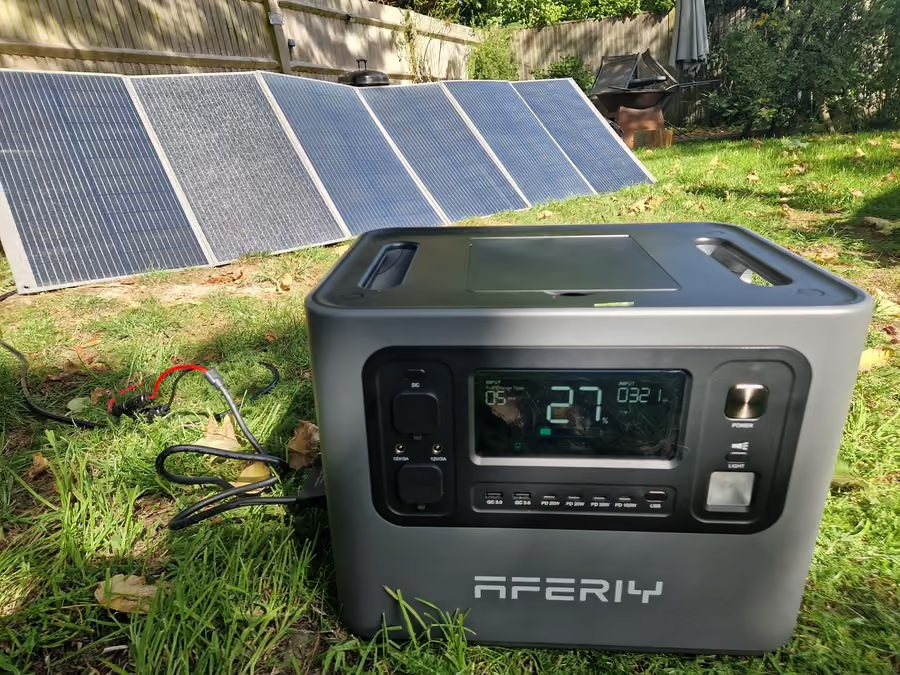
This is where I'd look within AFERIY's current range:
AFERIY doesn't yet have the same brand history as Jackery, EcoFlow or Anker.
But purely in terms of how much battery and inverter you're getting for the money, they are extremely hard to ignore.
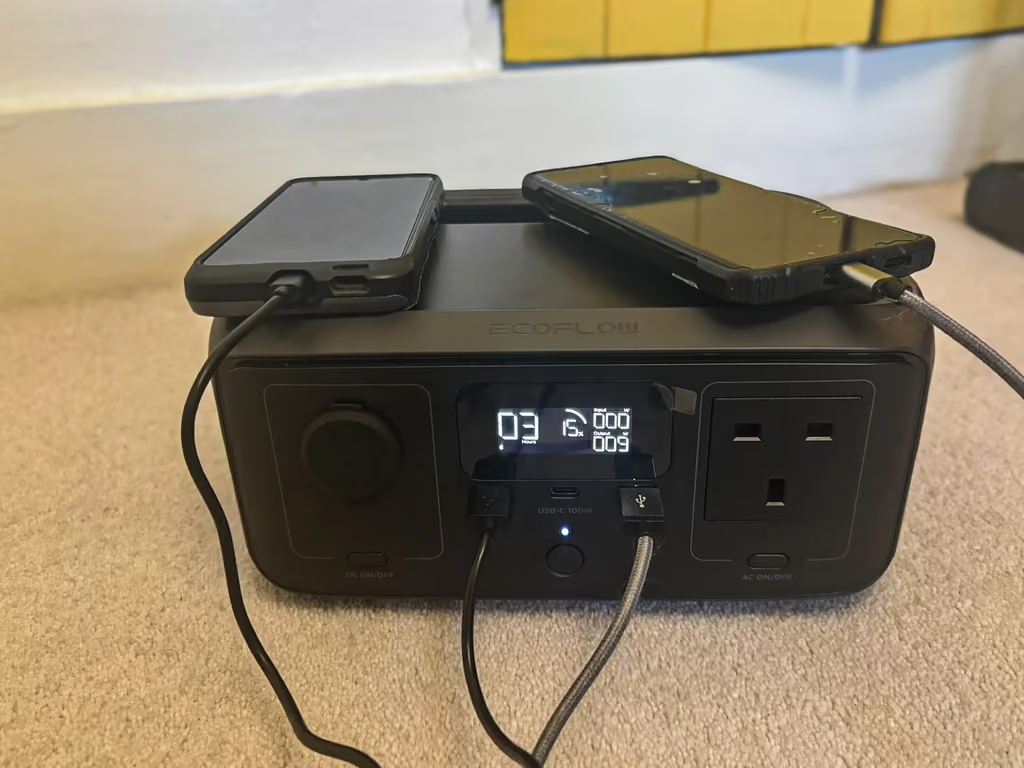
At the opposite end of the scale is the EcoFlow RIVER 3.
I spent a few weeks testing the EcoFlow RIVER 3, and it’s one of my favourite small power stations I’ve used.
It has a 245Wh battery, 300W AC output and weighs just 3.55kg, so this is definitely aimed at lighter use: phones, laptops, cameras, lights and smaller electronics rather than kettles or a full campervan setup.
What I like most is how genuinely portable it feels. It’s compact, really nicely balanced in the hand, simple to use and charges incredibly quickly.
The EcoFlow app is also one of the better power-station apps I’ve used, with control over charging speeds, battery limits and scheduling. That said, most people buying the RIVER 3 probably won’t even need it.
You can read all my testing in my full EcoFlow RIVER 3 review.
My takeaway: This station is brilliant for lightweight camping and travel, but only if your power needs are genuinely small.
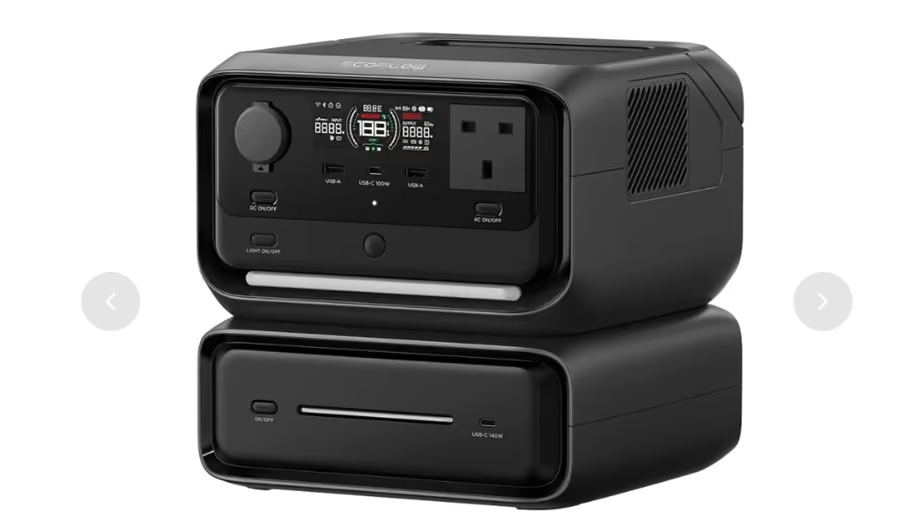
This is where EcoFlow's range gets interesting.
The RIVER 3 Plus steps up to 600W output and can be expanded with additional battery capacity.
And if you're doing a proper campervan setup and want around the 1kWh mark, I'd skip the tiny RIVER completely and look at the DELTA 3 series.
The DELTA 3 Plus sits at 1,024Wh / 1,800W and can be expanded further, while the larger DELTA 3 Max series moves into 2kWh territory.
That's what I like about EcoFlow.
You can buy into a similar design/app ecosystem at very different power levels rather than trying to make one station work for everyone.

I've probably tested more BLUETTI power stations than any other single brand.
So I'm pretty comfortable saying that BLUETTI deserves to remain high up this list.
We've tested:
That gives me a much better feel for the brand than simply unboxing one model for an afternoon.
The main downside?
BLUETTI's range can be confusing as hell.
There are loads of model names, generations and battery expansion options.
If you're currently shopping around the mid-size camping/campervan level, the BLUETTI AC70 is where I'd start.
It gives you:
That puts it nicely between the tiny RIVER-style units and the bigger 1-2kWh power stations.

The newer Elite 100 V2 is much closer to the 1kWh sweet spot, with 1,024Wh capacity and 1,800W output.
And if you're looking for a serious long-stay campervan or off-grid setup, the Elite 200 V2 jumps to more than 2kWh.
This is what BLUETTI does particularly well.
You can go from genuinely portable camping units all the way into big expandable setups without leaving the ecosystem.
My personal experience with their older AC60/B80 combination is also why I like expansion batteries so much.
Sometimes you don't need more inverter power.
You just need the same devices to run for longer.

The exact Anker we tested was the Anker 767, now known as the SOLIX F2000.
And this thing is big.
2,048Wh battery.
2,300W AC output.
Wheels and a retractable handle.
We actually used it as one of the main power sources while renovating our boat for around two months.
It was ridiculously capable.
In fact, we still have it and it now lives in our summerhouse, providing power down the end of our garden. 3 years in, it's going strong as ever.
We also tested Anker's PS200 solar panel with it.
The downside is that the F2000 is now an older model and isn't the unit I'd point most campers towards today.
If I wanted a current Anker at a much more sensible size, I'd start with the Anker SOLIX C1000 Gen 2.
It gives you:
At around 11.3kg, it also avoids the problem we had with the old 767/F2000 where portable really meant “thank god they put wheels on it”.
If 1kWh is still far too much, the SOLIX C300 is the little camping model I'd look at.
If you want to go the other way, the new SOLIX C2000 Gen 2 has a 2,048Wh battery, 2,400W output and expandable capacity.
That's why I wouldn't dismiss Anker simply because the exact unit we personally tested was much larger.
My firsthand experience tells me what their high-end build and design can be like.
You then choose the capacity that actually makes sense for your life.

Jackery was actually the first portable power station brands we ever used.
We extensively tested the original Explorer 500 and wrote a full Jackery power station review.
At the time, one of the big appeals was simplicity.
Plug things in.
Turn the output on.
See what power is coming in/out.
Done.
The market has changed a lot since that original Explorer 500 launched, and I wouldn't recommend buying the old model just because it's the one we used.
The current equivalent I'd start with is the Jackery Explorer 500 v2.
It's a 512Wh / 500W LiFePO4 station weighing just 5.7kg.
For a normal weekend camper, that's a really sensible combination.
Enough capacity to be genuinely useful without stepping into a giant battery bank you may never exploit.

If the 500 v2 doesn't fit, Jackery now has a nicely staggered range:
If you're someone who hates comparing 15 near-identical variants (I'm looking at you BLUETTI), Jackery is still one of the easier ranges to understand.
And for travel, that matters.
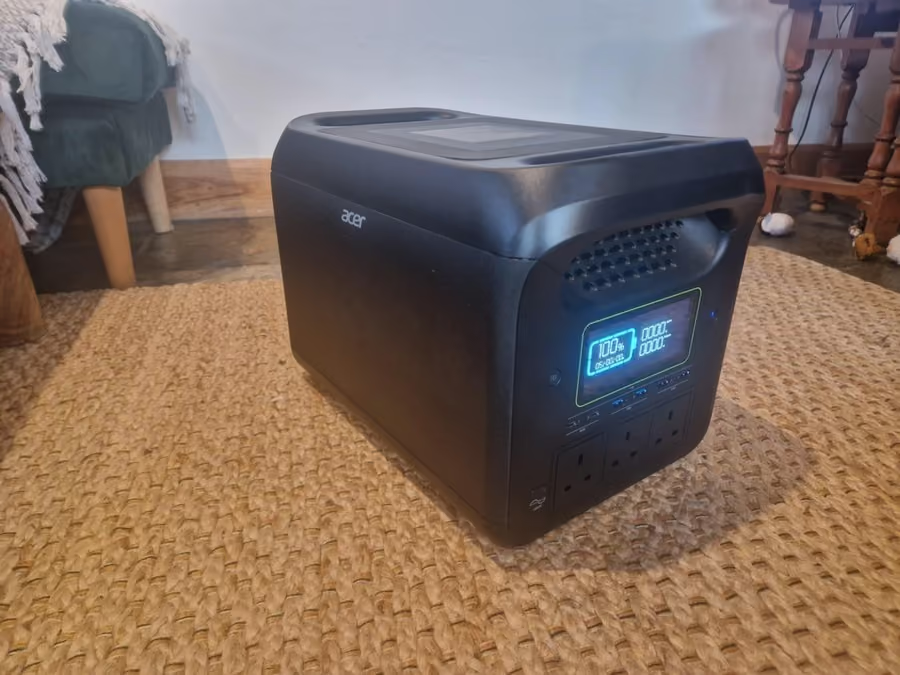
Acer was the one that surprised me.
Because when I think Acer, I think laptops.
Not giant batteries.
We tested both their 600W and 1800W stations side-by-side, and you can see the full results in my Acer portable power station review.
Their 1800W Portable Power Station has:
It's heavier than the AFERIY P180 Pro and modern 1kWh Anker units, so it wouldn't be my first pick if I expected to carry the thing around all day.
But for something that lives in the van, tent awning or home most of the time?
It's a very capable unit from a huge established electronics company.
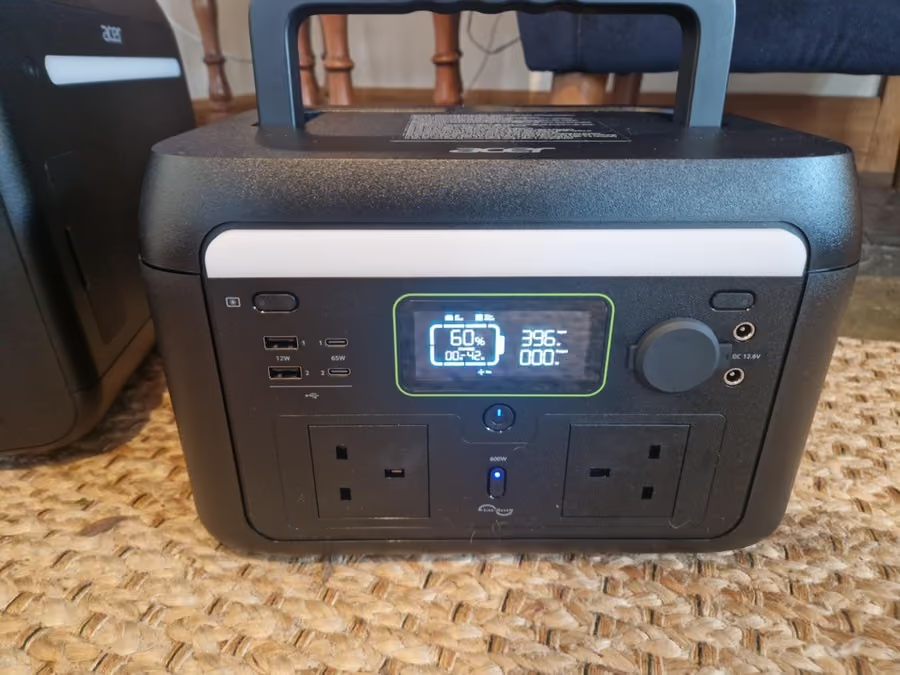
This was important when I first reviewed them because I tested both ends of their original portable range.
The 600W Acer is much better suited to lighter camping use.
And Acer now also lists a 3000W power station for people who need significantly more power.
They're still nowhere near as synonymous with portable energy as EcoFlow, Jackery or BLUETTI.
But I don't think that should automatically rule them out.
In fact, (at least at the time of writing), they sell ACER power stations at Curry's in the UK. So if you're of the mindset of wanting to go and see these stations and buy from a physical retailer, from a brand you've known your whole life, they're worth considering.
Growatt is an interesting one because portable batteries aren't their entire identity.
They've long been heavily involved in solar/inverter technology.
The model I personally tested was the VITA 550, a 538Wh / 600W station.
It was a genuinely useful small unit, with wireless charging, app control, multiple outputs and up to 240W solar input.
The VITA itself is now much harder to recommend as the obvious current buy in the UK, so I'd move up to the Growatt INFINITY 1300.
That gives you:
For somebody building a setup around solar, that 800W input is particularly useful.
Just remember that a panel's headline wattage is not what you should expect every hour of the day.
Solar generation changes with cloud, shade, panel angle and the strength of the sun. The Energy Saving Trust explains the same basic principle for fixed solar systems: orientation and shading can make a very meaningful difference to output.
So don't think:
“800W of panels × eight hours = guaranteed 6.4kWh today.”
It doesn't work like that.
This is the part I think matters more than brand.
People get far too hung up on whether EcoFlow is better than Jackery or BLUETTI is better than Anker before answering the much simpler question:
How much battery do you actually need?
And there are two different numbers to understand.
The US Energy Information Administration gives a good explanation of the distinction:
So a 1,800W power station doesn't necessarily last longer than a 500W one.
It simply means the inverter can supply more power at once.
These are deliberately rough.
Your exact answer depends completely on what you plug into it.
A laptop pulling 50W is one thing.
A 2,500W kettle is another.
This is where people get caught out.
You can own a giant battery and still not be able to run a certain appliance if the inverter isn't powerful enough.
As an example, when testing the AFERIY P180 Pro, our kettle alone pulled around 2,650W.
The station is rated to 1,800W.
So it eventually tripped its overload protection.
That's why, before buying any power station, I'd make a quick list of your highest-draw appliances and check their wattage labels.
If you mainly charge laptops, phones and camera batteries, you really don't need a giant inverter.
Yes... for some campervan builds.
But definitely not all of them.
We spent years living with a proper built-in electrical setup using leisure batteries, solar, an inverter and alternator charging.
We've also used Roamer lithium batteries extensively.
So I've now lived with both approaches.
For a basic weekend campervan conversion, power stations are ridiculously easy.
You don't need to design an entire battery bank.
You don't need to separately buy an inverter.
You don't need to build a control panel.
You can take the whole thing out of the van.
And if you sell the van, the power system isn't permanently attached to it.
For someone running:
...a 1kWh-ish station plus solar could be all you need.
We've even run energy-hungry gear such as our Zero Breeze portable air conditioner as part of our van setups, although something like that massively increases the amount of battery and charging capacity you need.
If I was building another van to live in full-time, I'd still seriously consider a traditional installed system.
Why?
Because you can design it specifically around the van.
You can permanently wire lights, pumps and fridges.
You can size the inverter independently from battery capacity.
You can install proper solar arrays.
And you can use dedicated DC-DC charging from the alternator.
It's also easier to repair/upgrade one component without replacing the entire box.
I've explained the complete setup we used in our DIY campervan electrical system guide.
For me, the simple rule is:
Weekend/simple camper = power station makes loads of sense.
Full-time complex conversion = I'd still price up a proper installed system before deciding.
This is your fuel tank.
The bigger the Wh number, the more stored energy you have.
But don't assume every last watt-hour printed on the box will arrive at your appliance.
There's always conversion loss through inverters and electronics.
This tells you how large an appliance the inverter can power.
If you want to use kettles, coffee machines, hair dryers, induction hobs or similar high-draw appliances, this can matter more than total capacity.
This is massively underrated.
A 20kg power station is technically portable.
So is a suitcase.
That doesn't mean you want to carry it back and forth across a campsite every day.
For genuinely portable use I love that 3-12kg sort of zone.
Once you move far beyond that, I want wheels or I want the unit to basically live in one spot.
Most modern stations now charge dramatically faster than the older models we started testing.
That's brilliant if you're travelling.
If you've only got an hour at a campsite hookup or friend's house, being able to dump a huge amount of power into the battery quickly can completely change how useful it is.
I also like units that let you slow the charge down when there's no rush.
If you're camping off-grid, don't just ask:
“Can it take solar?”
Almost all decent modern stations can.
Ask:
“How much solar can it actually accept?”
A 100W solar limit on a 2kWh battery is very different to a 1,000W input.
Also remember that portable solar rarely sits at its headline output all day. Energy Saving Trust highlights how heavily shade and orientation affect solar generation.
Basic cigarette-lighter charging is usually slow.
If you're driving for hours every day, newer high-output alternator chargers from brands like EcoFlow and Anker can make a lot more sense.
That's one feature I'd pay increasing attention to for a long-term van life setup.
Most of my favourite current stations have now moved to LiFePO4.
That's generally what I'd be looking for nowadays.
But chemistry isn't the whole safety story.
Good design, a proper BMS, temperature monitoring and using the unit within the manufacturer's instructions matter too. The UK Government's guidance on lithium battery protection systems gives useful background here.
And once a battery reaches end of life, don't throw it into household waste. The UK Government also has guidance on recycling batteries and electrical products.
More stations now advertise ultra-fast switchover for computers, routers and other devices.
This can be useful, but I wouldn't automatically assume a power station is a replacement for a specialist UPS for sensitive equipment.
ENERGY STAR has a useful overview of dedicated UPS systems and how they're designed.
For most camping users, this feature is a bonus rather than a reason to choose one station over another.
I think this section matters.
A “best” guide isn't very useful if products get added once and then live here forever because there's an affiliate link attached to them.

We previously included ALLPOWERS and I had a good experience testing the ALLPOWERS R600.
The R600 itself had a lot going for it, especially for the money.
However, I'm no longer comfortable keeping ALLPOWERS in my top seven based on the current level of customer-service and warranty complaints around the brand.
That doesn't mean my original review has changed.
It means the market has moved, and my recommendation has moved with it.

I also spent more than a month testing the Zero Breeze ElecHive 2500.
It was a seriously interesting 2.5kWh station and gave me another useful comparison point against the bigger Anker/BLUETTI-style units.
But Zero Breeze no longer sells the ElecHive power station range.
So there's no sensible reason to keep recommending it as one of the best stations to buy today.
That's different from the Zero Breeze portable air conditioner, which is a separate product category entirely.
For most people, I think the sweet spot is somewhere between 500Wh and around 1,000Wh, depending on what you're powering.
If I wanted a very small station for phones, lights and electronics, I'd look at the EcoFlow RIVER 3.
For a more complete camping/campervan setup, I'd move towards something like the AFERIY P180 Pro, BLUETTI AC70 or one of the 1kWh models from Anker/Jackery.
For a normal weekend trip, it can be.
If you're mostly charging phones, camera batteries, lights and a laptop, 500Wh is a useful amount of energy.
Add a power-hungry fridge or electrical cooking and it disappears much faster.
For a simple campervan setup, yes, absolutely.
Especially if you're recharging via solar or driving regularly.
If you're living in the van full-time, using electrical cooking, heating/cooling or other high-draw appliances, I'd want either more battery capacity or an expandable system.
Yes – if its inverter is powerful enough for your kettle.
Don't just look at battery capacity.
Check the kettle's wattage.
Our home kettle pulled around 2,650W when I tested it, meaning plenty of 1,800W stations won't run it continuously.
Lower-wattage camping kettles are much easier.
Usually, yes.
Most stations support basic 12V/24V car charging.
However, standard cigarette-lighter charging can be very slow.
For serious campervan use, I'd look closely at whether your chosen brand offers a higher-output alternator/DC charging option.
For camping?
100%.
I think they're one of the most useful additions you can make to a modern camping setup.
For campervans, it depends.
A power station is unbelievably simple and may replace the need for a full electrical installation in a basic build.
For complicated full-time conversions, a traditional custom electrical system may still be better.
Hopefully this guide has helped narrow things down a bit.
If there’s one thing I’d take away, it’s this: don’t just buy the biggest power station you can afford.
Work out what you actually need to power, how long you need it to last, how you plan to recharge it, and then choose the smallest unit that comfortably covers that.
For us, that’s why there isn’t one single “best” option.
Anyhow, it's over to you now:
Drop a comment below and I will help where I can!



Leave a comment
Let us know what you think!