



Heading to the Philippines and trying to decide which eSIM to buy?
Well, firstly, good choice on destination.
The Philippines is one of my favourite places to visit in the entire world!
So, whether your plans involve beaches in Palawan, a few days exploring Cebu, or heading over to Siargao, mobile data is one of those things I'd rather sort before the trip starts.
Because once you've landed, found your luggage and worked out where you're staying, the last thing you want to be doing is hunting for WiFi just to open your booking confirmation.
And I won't lie to you, Philipines WiFi isn't always there, and it ain't always fast!
So I'd have your own source of data!
Below, I've rounded up five eSIM options for the Philippines, with a look at who I'd choose each one for, the features worth paying attention to, and the drawbacks to check before buying.
Travelsim Asia would be my first stop for straightforward setup and flexible hotspot use. But, the right choice depends on whether you mainly need data on your phone, plan to share it with a laptop, or want something you can keep using on future trips.
One thing to remember whichever company you choose: coverage can get patchy in remote areas. I'd download maps and save accommodation details before heading somewhere quieter, particularly if you're relying on your phone to find your way.
Prices mentioned below are in US dollars and were checked on September 2026. Check your chosen plan before buying, as prices and features can change.
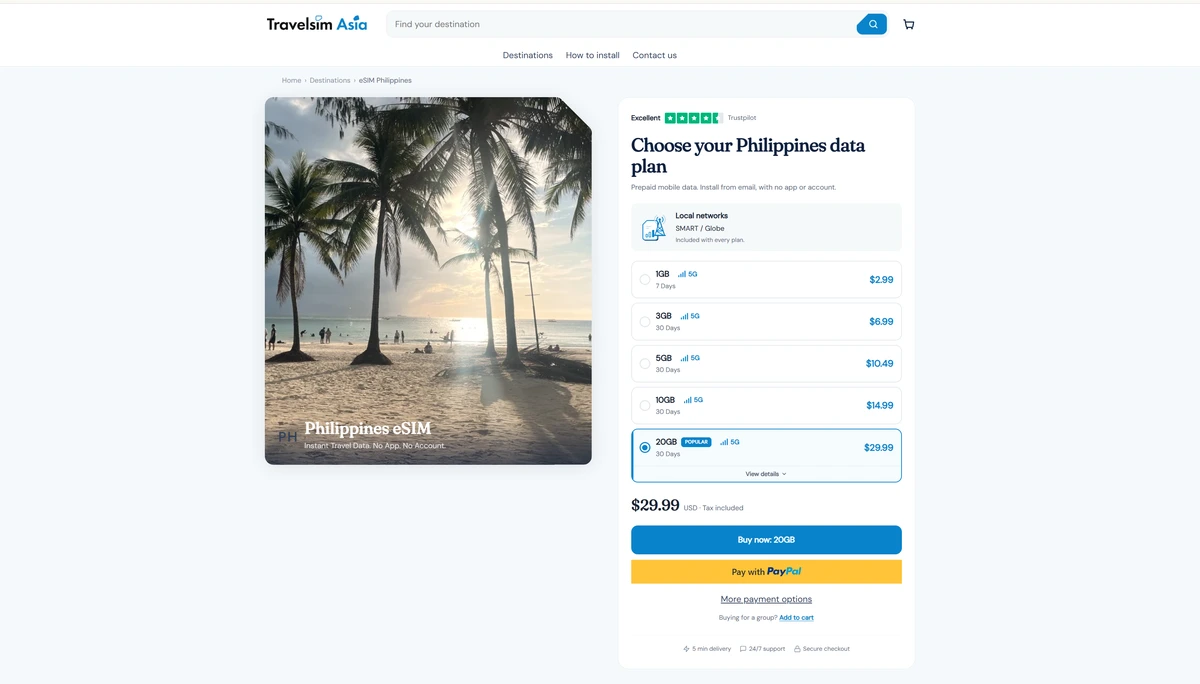
Travelsim Asia is the option I'd start with if you want to get your data sorted without adding another app to your phone.
You receive the installation details by email, with no app or account required.
You manage your eSIM through an anonymous dashboard link, where you can check usage and top up. They say they only collect the customer information needed to provide the service and never send marketing emails. (This is nice!)
Their Philippines plans list Smart and Globe as the local networks, with 5G where available and you've got 24/7 support.
For me, the most useful feature is being able to use the whole data allowance through hotspot, without a separate tethering cap.
When you're travelling as a couple, I'd always check that before buying two separate plans.
If one person mainly needs occasional access, sharing a connection might be enough. Of course, that only works while you're together, so I'd still want my own data if we were heading off separately.
It's also worth thinking about what your laptop does in the background. I'd pause cloud backups and big downloads before connecting, otherwise a quick bit of work could eat into the holiday's data budget.
The options currently run from 1GB for seven days at $2.99 to 20GB for 30 days at $29.99. The 10GB plan costs $14.99 and also lasts 30 days.
There's a 180-day activation window, and validity starts when you first connect at your destination.
All plans can be topped up or extended if you need more data or your trip runs longer. Travelsim Asia chooses to sell fixed-data plans rather than unlimited packages, so you know exactly how much data you're buying. I'd still compare the allowance and price with your expected usage before choosing.
I'd start by checking how much mobile data you normally use in a week. It's a better starting point than automatically buying the biggest package because you're going abroad.
They also say they update their Philippines eSIM comparison twice a month and recommend competitors where they think another option is better - which is pretty transparent and authetnic if you ask me.
For me, the appeal is how little you need to do to get connected. There’s no app to download or account to create: install your eSIM from the email, then manage it through an anonymous dashboard link. They also promise no marketing emails.
You can use 100% of your data allowance through hotspot, which is handy for sharing with a partner or connecting a laptop. All plans can be topped up or extended, and the 180-day activation window means you can buy well ahead of your trip.
They stick to fixed-data packages rather than selling unlimited plans, so you know exactly how much data you’re paying for. If you need help, support is available 24/7.
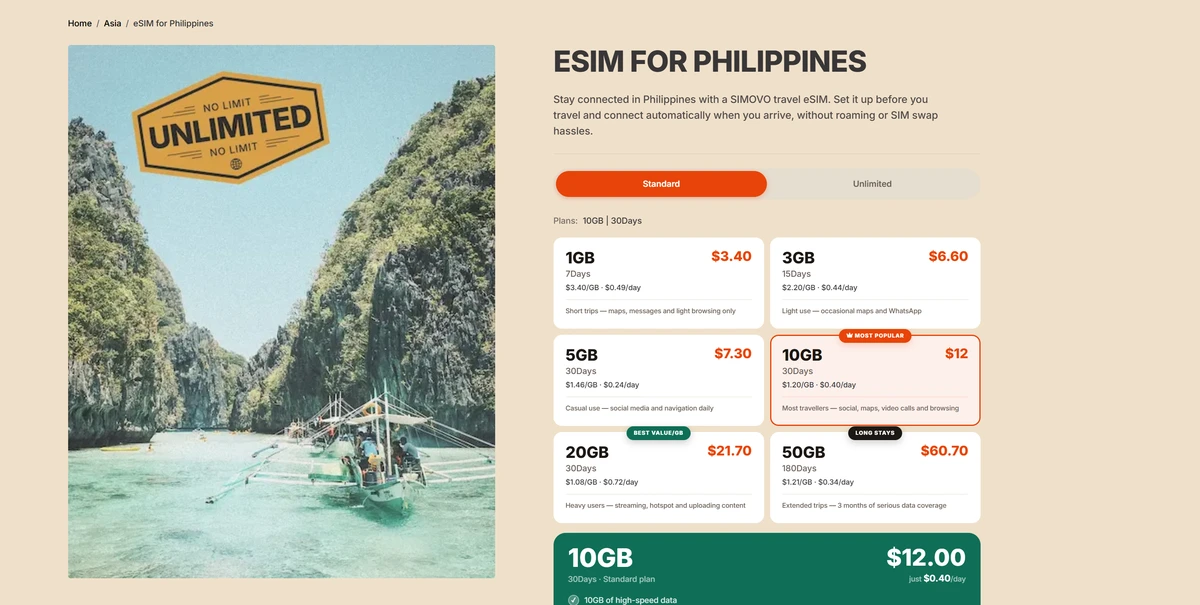
Simovo is worth a look if you want to keep the cost down.
Its current 30-day plans include 5GB for $7.30, 10GB for $12 and 20GB for $21.70. The latter two are cheaper than the equivalent Travelsim Asia allowances above.
I'd happily compare those options for a holiday where most of my phone use would be finding places, messaging and checking bookings. I'd rather put the saving towards something on the trip than buy more data than I'm likely to use.
Simovo also offers unlimited plans, but it's worth understanding how those work. You choose a daily high-speed allowance, with slower data after you've used it until the allowance resets.
That distinction matters if you're planning to upload videos or work from your phone. Staying connected is useful, but a slower connection might not suit the job you need to finish.
The product page lists 4G connectivity, hotspot support and a 180-day installation window, with the plan starting on connection at your destination.
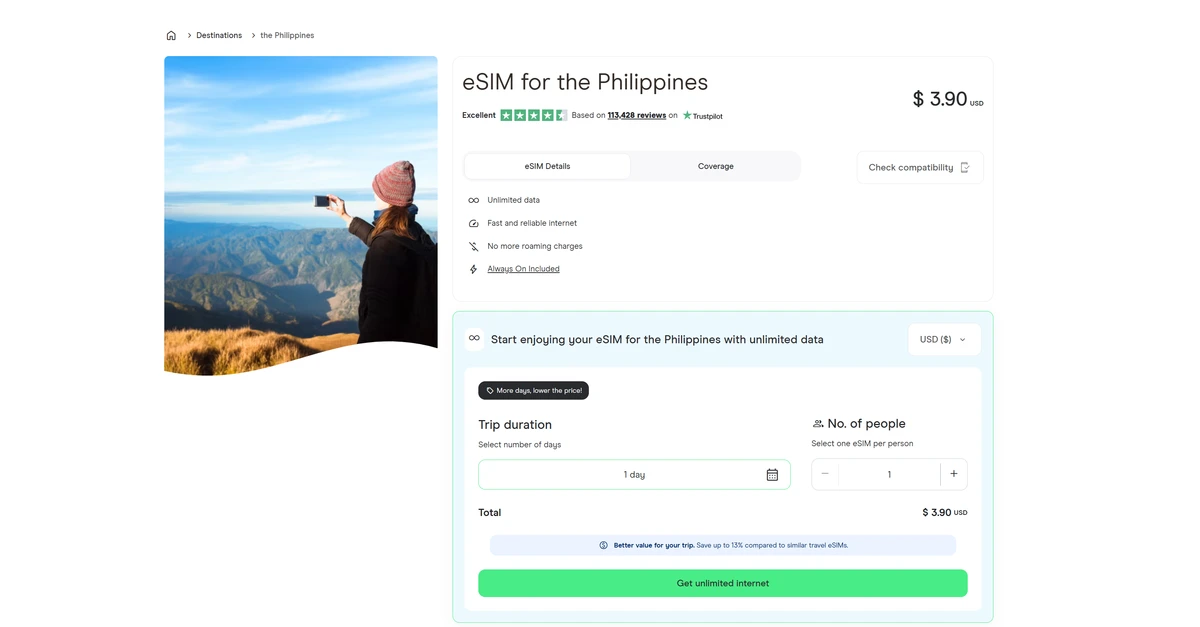
Holafly would be on my shortlist if I didn't want to keep checking a remaining data balance.
Its Philippines eSIM offers unlimited data for your chosen duration, connects through Globe, and includes 24/7 support. Listed prices include $27.50 for seven days, $50.50 for 15 days and $73.90 for 30 days.
Whether that's worth paying comes down to how you travel. If your phone spends most of the day in your bag while you're out exploring, I'd question how much value you'd get from unlimited data.
If you're constantly using it, the convenience may be worth the extra spend.
The detail I'd pay attention to is hotspot: this particular plan allows 1GB of sharing per day. That could be restrictive if you're buying it mainly to connect a laptop.
I'd work out what I needed to do on the laptop first. Sending a few emails is a very different requirement from uploading a folder of video footage.
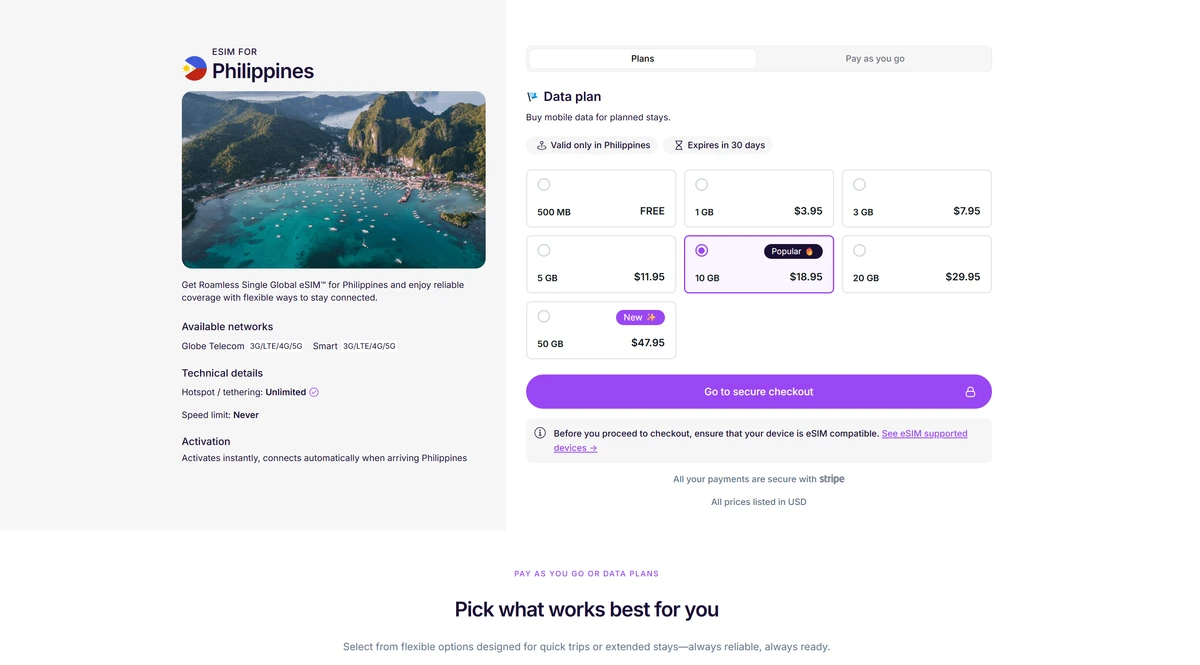
Roamless is the one I'd look at if the Philippines is just one stop on a longer trip.
It offers a reusable global eSIM, with a choice of data plans or pay-as-you-go credit. Purchased credit doesn't expire, and you manage it through the app.
I can see the appeal if you travel regularly and don't want to start researching a new eSIM every time you book a flight.
For example, I'd be more interested in this setup for a trip with several country stops than for a single week away. Having one place to manage everything would make the planning a little easier.
I'd still compare the Philippines rate with a fixed package before adding credit, though. Convenience would influence my choice, but I'd want to know what it was costing me over the whole trip.
Also, don't confuse non-expiring credit with a data plan that lasts forever. Check the validity of any specific package you buy.
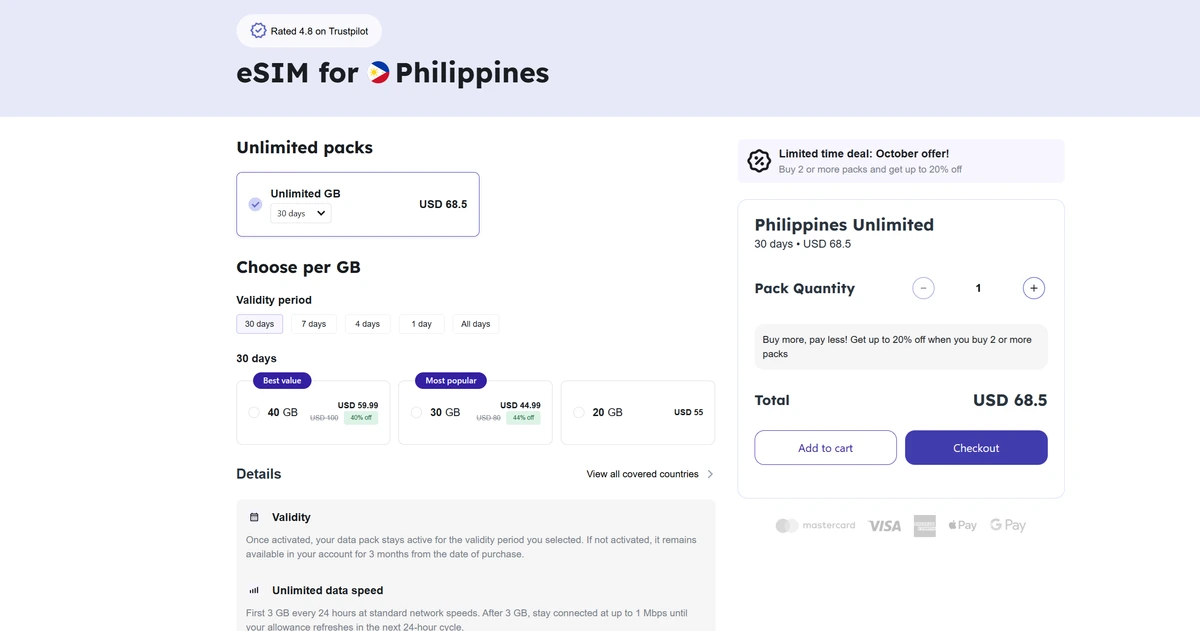
Jetpac is worth comparing if you'd make use of a few extras alongside your data.
On eligible packs of 3GB and above, it advertises continued access to WhatsApp chat, Grab, Uber and Google Maps navigation when your data runs out.
That's the sort of extra I can see myself valuing when arriving somewhere unfamiliar. I'd still save the accommodation address beforehand, but having another way to navigate would be reassuring.
Jetpac also advertises SmartDelay lounge access, subject to registration and eligibility. I'd treat that as a bonus when comparing plans, rather than the reason to choose one.
It offers fixed-data and unlimited options. The unlimited plan currently provides 3GB at standard network speeds per 24 hours, then up to 1Mbps until the next cycle.
For me, that means thinking about my busiest day of use, not just an average day. A big upload could change how useful the connection feels for the rest of that period.
So those are the five options I'd compare for a Philippines trip.
I'd start with Travelsim Asia for simple setup, then check Simovo before deciding what to spend. If you prefer unlimited phone data, look at Holafly; for repeat trips, consider Roamless; and if the travel extras appeal, compare Jetpac.
Before paying, check your exact phone model supports eSIM and that it's unlocked. I'd also install using a reliable internet connection before departure, follow the provider's activation instructions, and make sure my home SIM isn't being used for mobile data abroad.
Got any questions about choosing an eSIM for the Philippines? Drop them below!
Love,
Cazzy



Leave a comment
Let us know what you think!