



Heading to Malaysia and trying to decide which eSIM to buy?
Whether you're planning a few days in Kuala Lumpur, eating your way around Penang, heading to the beaches of Langkawi or adding Malaysian Borneo to your itinerary, getting your mobile data sorted before you leave makes the arrival a little easier.
I'd much rather be working out where to go for dinner than trying to find WiFi so I can open the address of the hotel.
Below, I've rounded up five eSIM options for Malaysia, including who I'd choose each one for, what makes them worth considering, and the drawbacks to check before buying.
My top pick is Travelsim Asia. Its combination of straightforward setup, fixed-data plans and hotspot flexibility makes it a good fit for the way I like to travel.
Prices mentioned below are in US dollars and were checked on 1 October 2026. Check the current price, validity and features of your chosen plan before buying.
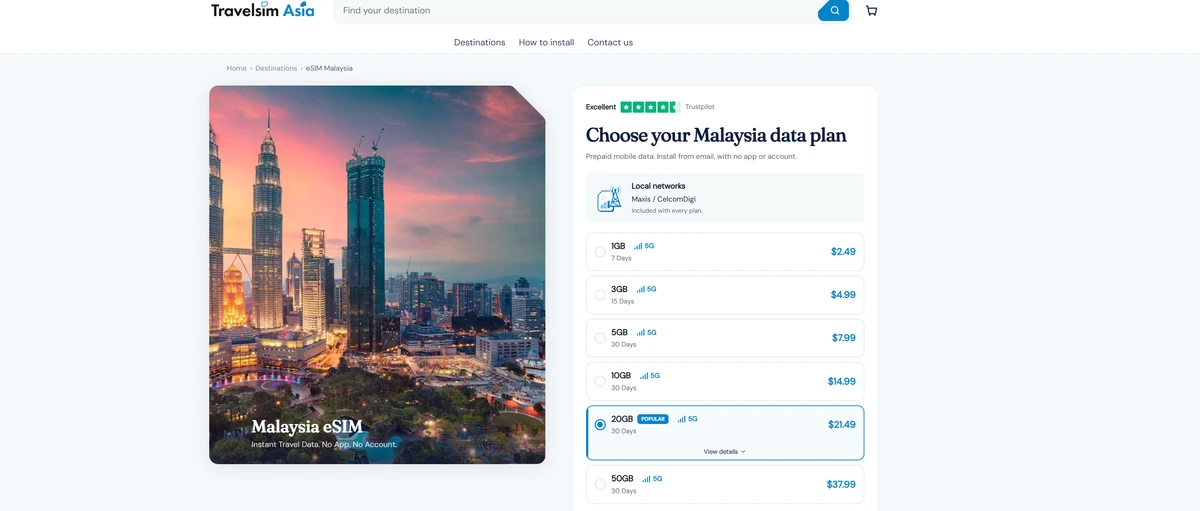
Travelsim Asia is the option I'd start with if you want a straightforward Malaysia eSIM without another app to manage.
You install from the email they send you, with no account required. Checking your balance and buying extra data happens through a dashboard link, so there's no need to remember another password halfway through your holiday.
I like that approach. Before a trip, there's already enough to organise between flights, accommodation and working out how to get from one place to the next. Mobile data should be one of the easier jobs to tick off.
The feature that matters most to me is being able to use 100% of the data allowance through hotspot.
That gives you flexibility if you want to connect a laptop, share with your partner or get a tablet online. You're still using up the data you've paid for, but there isn't a separate daily hotspot allowance to work around. See the Malaysia plan features.
If you've read my other eSIM guides, you'll know hotspot is something I pay attention to. When you're travelling and working, buying a plan that suits your phone but barely covers your laptop can be frustrating.
I'd still pause automatic backups before connecting a computer. It's easy to forget about everything running in the background when all you meant to do was answer a few emails.
Travelsim Asia lists Maxis and CelcomDigi, with 5G available on compatible devices where coverage allows. The Malaysia plan includes both Peninsular Malaysia and Sabah and Sarawak, so you can keep the same eSIM when flying over to Malaysian Borneo.
For a route taking in Kuala Lumpur, Penang and Langkawi, that's a convenient setup. If you're heading further into Borneo, I'd check reception at your actual accommodation rather than assume that countrywide coverage means a signal at every stop.
A remote lodge, rainforest excursion or boat journey is a different situation from a city hotel. I'd ask the accommodation which network works there and save tickets, pickup details and maps before setting off. Malaysia coverage also doesn't automatically include Brunei or Indonesian Borneo.
Travelsim Asia’s Malaysia plans start at $2.49 for 1GB, valid for seven days, followed by 3GB for $4.99, valid for 15 days.
If you need more data, the 30-day options include 5GB for $7.99, 10GB for $14.99, 20GB for $21.49 and 50GB for $37.99. I’d look at 5GB for a week of maps, messaging and occasional social media, with WiFi for heavier use.
For a longer trip, regular video calls or sharing a hotspot, one of the larger allowances could make more sense.
As a starting point, I'd look at 5GB for a week of maps, messaging and occasional social media, with WiFi for heavier use. For two weeks, I'd compare 10GB options. Regular video calls, uploads or sharing with another person could justify more.
Those are planning estimates, not a promise about how long your data will last. Checking your normal mobile usage is a useful starting point, then allowing for anything you'll do differently on holiday.
Travelsim Asia's data guide also breaks down the different uses.
For me, it's the combination of simple management and knowing what you've bought.
Travelsim Asia sells fixed-data packages rather than unlimited plans. I can see the appeal of choosing an allowance, checking what's left and adding more if I need it. I'd rather make that decision around my actual use than automatically pay for unlimited data on every trip.
You have 180 days from purchase to activate, with the plan starting on its first connection at the destination. Top-ups go onto the existing eSIM through the dashboard, and support is available 24/7.
That would suit me if I wanted to buy ahead and have it ready before packing. I'd also save the dashboard email somewhere easy to find, rather than leave myself searching through flight confirmations when I needed more data.
The price comparison is worth keeping honest: Ubigi's 10GB package below costs less. My reason for putting Travelsim Asia first is the overall setup and flexibility, rather than claiming it wins at every price point.
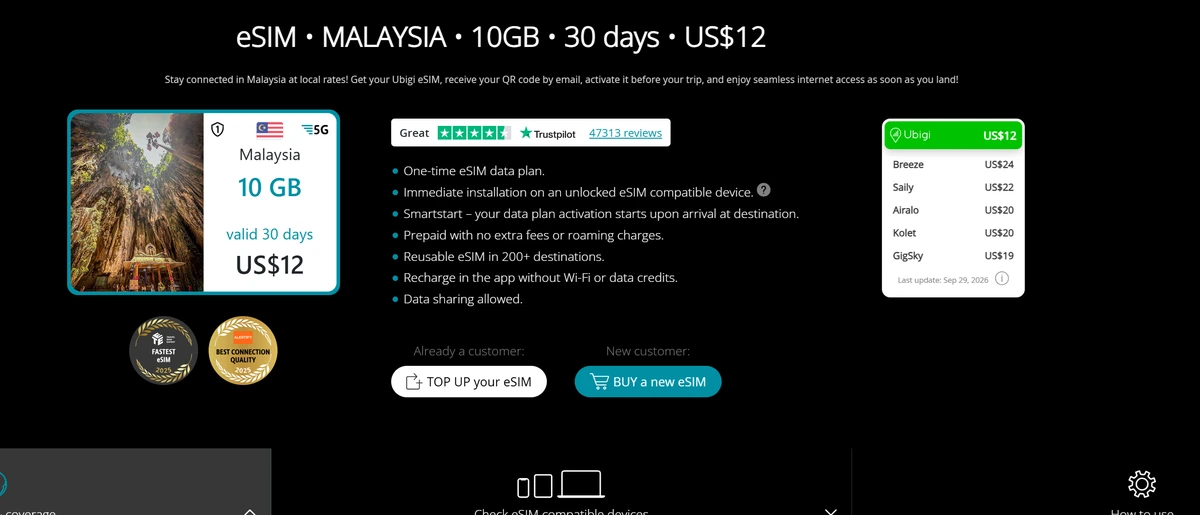
Ubigi is worth a look if you have a rough idea of how much data you'll need and 10GB fits the bill.
The Malaysia package linked here gives you 10GB for 30 days at $12, compared with $14.99 for the same allowance and validity from Travelsim Asia. It lists Maxis and YTL as its networks, and allows data sharing. See Ubigi's plan details.
I wouldn't ignore that saving. If you're happy with Ubigi's setup and those networks suit your route, it's a sensible alternative.
Its Smartstart feature begins the plan on arrival at the destination. You can also reuse the eSIM for later trips by purchasing the appropriate plans, and recharge through the app even without WiFi or remaining data credit.
That last feature is useful if you underestimate your usage. I'd still keep an eye on the balance, but being able to buy more without first finding another connection is handy.
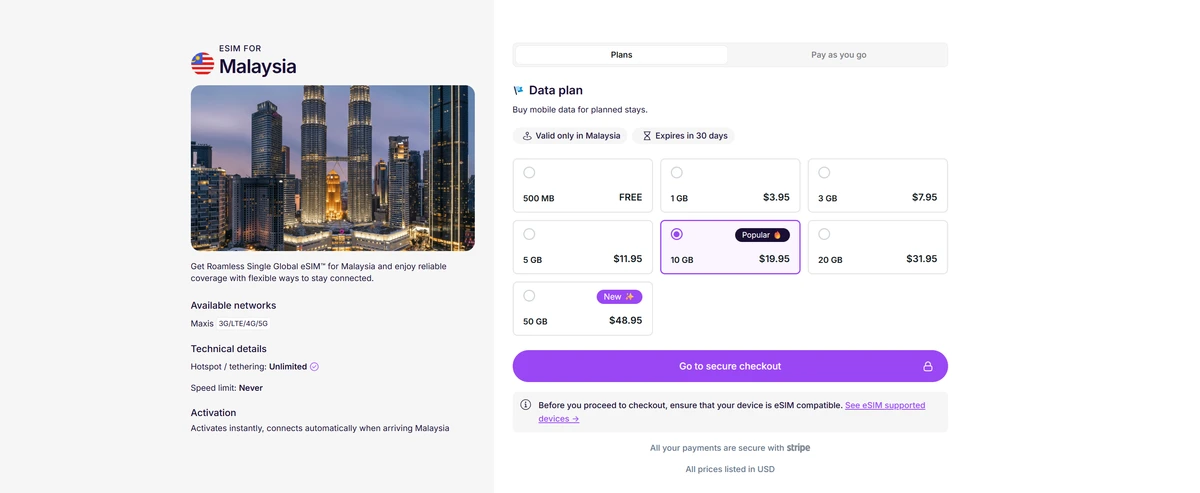
Roamless would be on my shortlist if Malaysia was one stop on a longer trip.
It offers a reusable global eSIM, with a choice of fixed plans or pay-as-you-go credit. Purchased credit doesn't expire, and you manage your balance and plans through the app.
I can see the appeal if you're heading onwards to other countries and want to keep the same eSIM installed. Just check that every stop is supported and compare the rate in each destination before adding credit.
For a one-off Malaysia holiday, I'd put more weight on the total cost of the data I actually needed. For several trips a year, I'd give the convenience more consideration.
One distinction worth remembering: non-expiring credit doesn't mean every fixed package lasts indefinitely. Check the validity and country coverage of the specific plan you're buying.
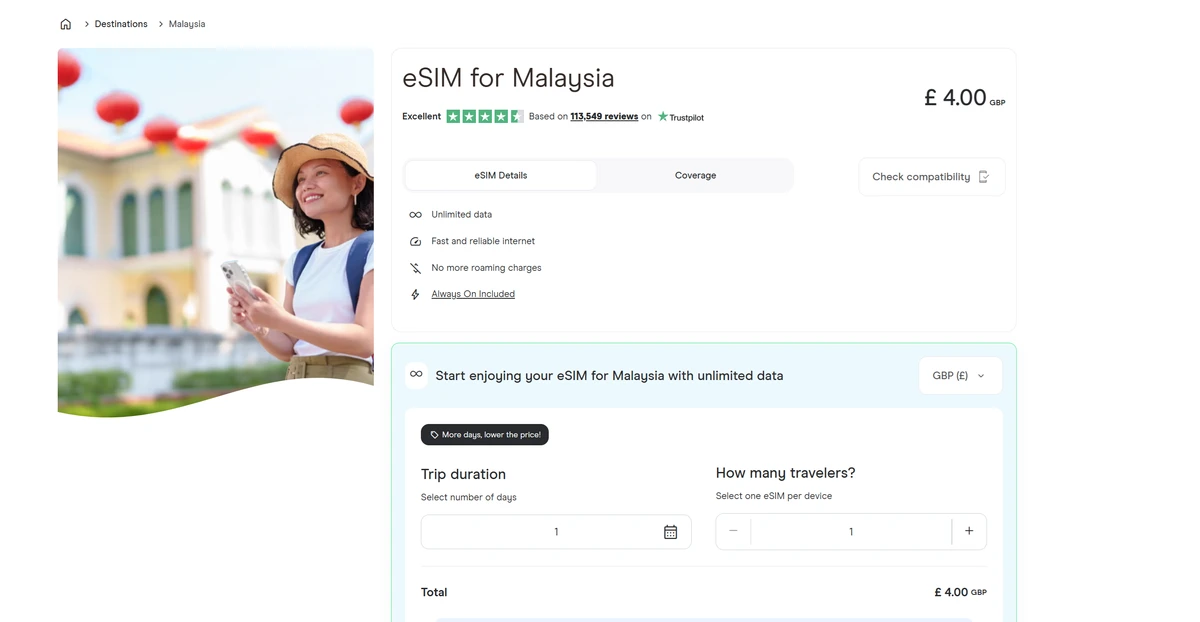
Holafly is worth considering if you'd prefer to buy data by trip length and avoid watching a remaining GB balance.
Its Malaysia eSIM offers unlimited phone data, lists Celcom/Digi and includes 24/7 support. Current prices include $27.50 for seven days, $50.50 for 15 days and $73.90 for 30 days.
Whether I'd pay that depends on the trip. If I mainly needed directions and messages, I'd start with a smaller fixed package. If I expected to use my phone heavily, the convenience would be more appealing.
The main catch for me is hotspot: the Malaysia plan currently allows 1GB of sharing per day. That could be restrictive if you're relying on it for laptop work.
Also, unlimited doesn't guarantee full speed at all times. Holafly says local operators may temporarily reduce speeds under fair-use policies.
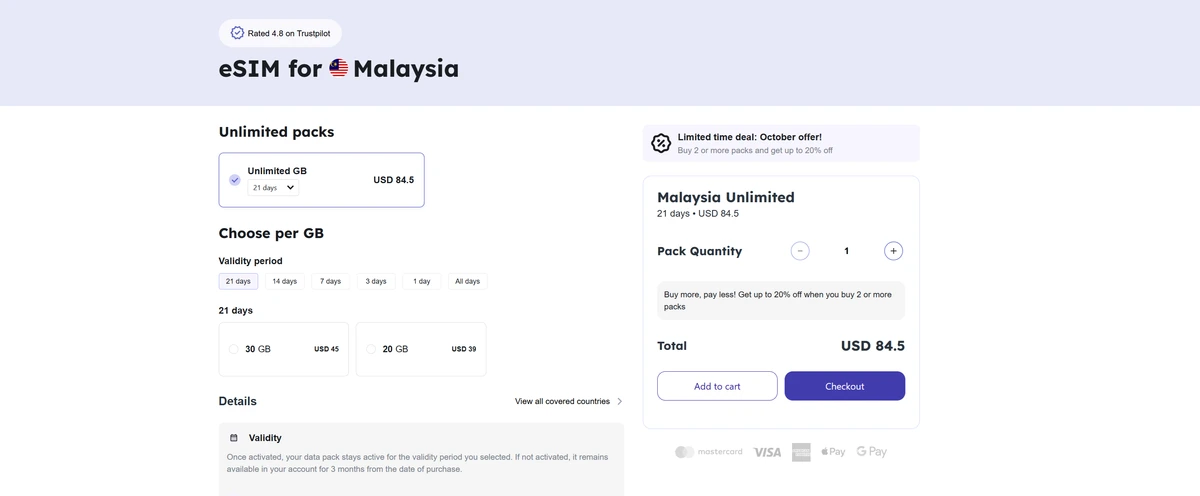
Jetpac is worth comparing if you'd use a few extras alongside your mobile data.
Eligible packs of 3GB and above include continued access to WhatsApp chat, Grab, Uber and Google Maps navigation after your data runs out. Hotspot is supported too.
Being able to send a message or navigate back to the hotel would be useful if I misjudged my allowance. I wouldn't buy a plan purely for that, but it's a practical extra to consider.
Jetpac also advertises SmartDelay airport lounge access, subject to registration and eligibility. I'd view that as a bonus rather than assume every delayed flight gets you into a lounge.
There are fixed and unlimited packages. For the unlimited option, the current terms specify 3GB at standard network speeds per 24 hours, followed by up to 1Mbps until the next cycle.
I'd pay attention to that if I had large uploads planned. A single busy afternoon could affect the connection available for the rest of the period.
So those are my five picks for getting connected in Malaysia.
Travelsim Asia would be my first choice for straightforward setup, flexible hotspot use and a range of fixed allowances. I'd compare Ubigi if 10GB was the right size, Roamless for regular trips, Holafly for unlimited phone data and Jetpac if the extras suited my plans.
Before buying, check that your exact phone model supports eSIM and is unlocked. Install over a reliable connection before departure, follow the provider's activation instructions, and make sure your home SIM isn't being used for mobile data abroad.
Got any questions about choosing an eSIM for Malaysia? Drop them below!
Love,
Cazzy



Leave a comment
Let us know what you think!